THIS HOTEL’s
exquisite furnishing coupled with a laid-back vibe are perfect for the
new-generation entrepreneur. Located at the heart of Singapore’s business
district near Chinatown, and surrounded by beautifully restored historical shop
houses, this brand new hotel offers easy access to the best that the city has
to offer. Its 386 guestrooms spread across 29 storey’s offer spacious deluxe
and executive designer rooms and suites, with executive rooms that boast a
skyline of the central business district, and that have ergonomic Herman miller
chairs, comfortable posturepedic
mattresses and 40-inch LED television sets.
Sunday, January 26, 2020
Wednesday, December 25, 2019
VILLA BORGHESE
# In the century,
Villa Borgheses’s once formal gardens were fully landscaped in a more
naturalistic style, before being
bought by the Roman authorities and given to the public in 1903
LAZILY STRETCHING OUT
across the northern perimeter of the city walls, the Villa Borghese looks down
upon the Piazza del Popolo and the trio of busy through fares that flow into
the centre of town. Once the lavish gardens of the 17th-century
cardinal who bequeathed the park its name, Villa Borghese has long been Rome’s
favourite place to escape the heat of the streets. Long winding alleys wrap
themselves around copses of trees, under which sit relaxing Romans of every
stripe-lovesick couples, furiously
smoking old men with shirts open to their waist, groups of teenagers
licking gelato. This is where the city comes to keep fit too – joggers,
cyclists and strollers keep the avenue moving throughout the day.
But this Rome, and even in a place as laid back as this,
high culture can’t help making an appearance. Villa Borghese is home to some of
the city’s finest museums – the Museo e Galleria Borghese, housed in the
Borghese Villa itself, showcases one of the best collections of Renaissance and
Baroque art in the world. In particular, the marble sculptures by Bernini on
display are some of the very best.
Another treat is the once-scandalous sculpture of Cardinal
Borghese’s wife, Pauline, the sister of Napoleon. The statue of her carved by
Antonio Canova, in which she insisted on being depcted naked as a goddess of
love, caused the cardinal so much embarrassment that he not only refused to
allow it to be displayed in public, but would only show it to close
acquaintances by torchlight. As wit hmost cultural artifacts that are censored,
the statue – and its subject – gained legendary status amongst the Roman
public, much to the cardinal’s chagrin.
The sculptures extend out into the park surrounding the
villa too. Busts and statues from 1,000 years of the city’s great and good are
scattered throughout, the unlucky with their noses broken off and the
favourites covered in lipstick kisses. The grounds of Villa Borghese are also
where Rome turns its cultural attention to the wider world. Ever since the
German polymath Johann Wolfgang Goethe took a holiday here-a visit that the
German government commissioning a statue of the great man to stand forever in
the park – foreign governments have been rushing to donate statues of their own
literary and artistic geniuses. So, in a 10-minute stroll, you’ll pass the
likes of Pushkin, Byron and Victor Hugo.
Just as the Roman Empire spread its influence across half
the planet, and the artists and architects of the Renaissance showed the world
what art could be, so at last, in some small way, the debt is being
acknowledged and the favour returned.
The Museo e Galleria Borghese is so popular that it’s
difficult to just turn up and get in – you’ll need to ring ahead and book a
ticket at least two hours in advance. (galleriaborghese.it).
Monday, November 25, 2019
TREVI FOUNTAIN
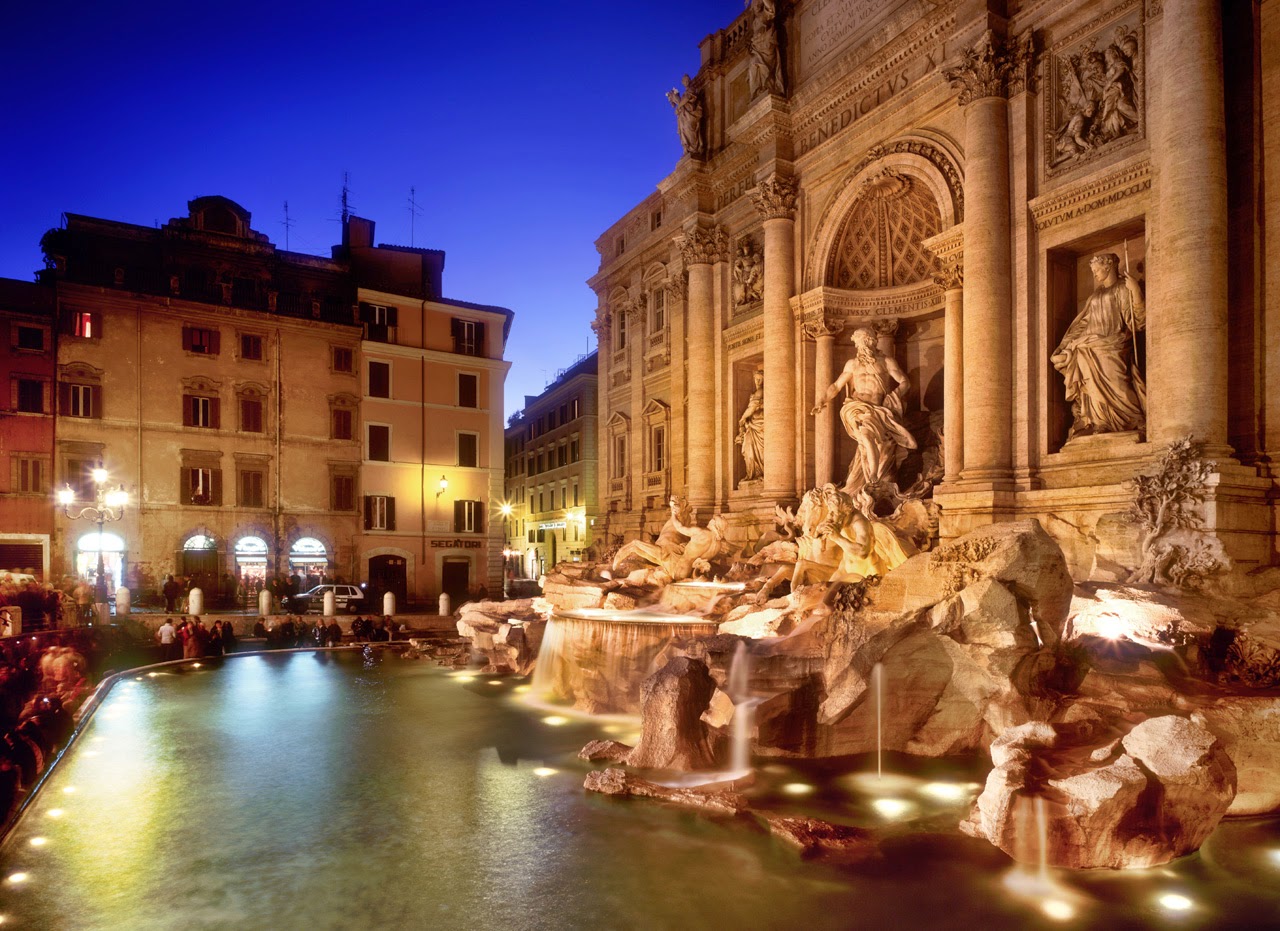
#The Trevi Fountain –
depicting Neptune, the Roman god of water and the sea
AS WORKPLACES GO,
THE Trevi Fountain takes some beating. Instead of toiling in a strip-lit
office, Alessio de Filippo gets to go about his daily grind beside a Baroque
masterpiece whose extravagant beauty pulls in thousands of visitors each day.
At 7am each morning, he plugs in a blue vacuum cleaner-like
machine, attaches the hose to a long metal handle, sticks it in the azure pool
of the fountain, and starts sucking. There’s rattle and a shudder as the
hundreds of coins at the bottom of the pool start to shoot up the tube and into
the machine. Every day, some 3,000 euros are thrown over tourist’s shoulders
and into the fountain – a gesture that is supposed to ensure a return to the
Eternal City. Alessio’s job is to collect the coins each morning and sitribute
them to the Catholic charity Caritas, based in the city.
Work on the Trevi began in 1732, a relatively late addition
to the Roman tradition of building celebratory fountains. The Romans were
exceptionally good at ensuring the imperial capital was well watered, and the
aqueducts and hundreds of drinking fountains that still dot the city streets
are testament to their success. The Trevi Fountains sits at the culmination of
a 2,000-year-old underground aqueduct
that brings water from the Salone springs, 11 miles away. It shows the god of
the sea, Neptune, being pulled along by two great winged horses, one placid,
one frenzied, representing the extremes of the oceans.
In recent years though, the Trevi has hit the news for reasons
other than its beauty. Those tourist coins have proven to be an irresistible lure
for numerous Romans – in particular one man, nicknamed D’Artagnan, who
surreptitiously his hands into the flush waters. Hence the need for Alessio to
hoover up the contributions each day. ‘I’ve seen so many people try to steal coins,’
he admits, in between suctions. ‘The scandal around D’Artagnan didn’t help
either – it was shown on the TV constanly, and only helped spread the word.’ In
the months after his arrest, the
numerous copycat attempts led to the security around the fountain being upped.
The Trevi Fountain continues to be wildly popular with
visitors, but has not been without its criticts. While architect Nicola Salvi
was overseeing construction, a barber who owned a shop on the corner of the
square was a persistent critic of the design. Eventually Salvi became so
irritated that he added a large vase-like structure to one corner, so that it
blocked the view of the shop from anyone standing in front of the fountain.
Locals today have nicknamed it ‘the ace’, due to its similarity to the ace of
spades from a pack of cards.
The only time that the Trevi Fountain isn’t absolutely
packed is first thing in the morning, so to limit your chances of hitting
another visitor with your coin, try to get there as early as possible.
Friday, October 25, 2019
ROMAN FORUM
#The front portico of
the Temple of Saturn, seen here in the foreground, stands at the foot of
Capitoline Hill in the western end of the Roman Forum
POLITICAL POWER AS WE
know it was invented in the ancient Roman Forum. It was a public square at the
centre of the imperial city. Lined with temples, senate debating chambers and
monuments. All decisions concerning the vast empire were made here. Today, it
is a vast, rock-strewn area studded with crumbled columns and rubble, alongside
several restored buildings. It was largely destroyed when the Western Roman
Empire collapsed in the late fifth century and, by the Middle Ages, it had
suffered the indignity of becoming a cow field. It wasn’t until the 18th-century
revival of interest in the Classical period that serious archaeoligcal
excavations began.
A stroll around the forum today is a trawl through layers of
history. Its central avenue – the Vias Sacra, or Sacred Way – was the route
taken by the Roman armies as they returned from newly conquered lands bearing
the spoils of their victories (and sometimes the dismembered bodies of their
vanquished foes). At the far end of the Via Sacra on Capitoline Hill, past the
rostrum from which emperors and senators would make speeches to friends, Romans
and countrymen, was the Temple of Jupiter Optimus Maximus; here animal
sacrifices were made to the most powerful of the Roman gods after each battle.
Under Michelangelo’s watchful eye in the 16th century, the temple
was converted into a cathedral, symbolizing Christianity’s takeover of Roman
authority, and this was the only reason it survived the plunder that left most
of the other building stripped of their marble and stone after the fall of the
empire.
Across the way stands the Temple of Antoninus andFaustina, a
huge columned temple, so sturdy that it withstood the many attempts to pull it
downs by local keen to use the stone for their own houses.
Best of all is the
insight provided by the remains of the Casa delle Vestali, the home to the
Vestal Virgins. Each year, six girls were selected by lottery to move into a
life of luxury at the temple of Vesta, goddess of the home, where for 30 years
their primary task was to ensure that the temple’s sacred flame never went out
– and to remain a virgin. The consequences for any Vestal Virgin who did not
live up to the demands were grim-those who didn’t remain chaste were whipped,
marched out of the city in disgrace and buried alive.
Stop off at the museum inside the Senate building, which has
the latest discovered artifacts. Guided
tours of the Forum in English are worth the price.
Wednesday, September 25, 2019
COLOSSEUM
#The Colosseum’s outer
walls have three levels of arches, articulated by Ionic, Doric and Corinthian
columns-marble statues once filled the niches on the second and third storeys
WHEN IT COMES TO
leisure, Roman tastes haven’t changed much in 2,000 years. Each Sunday, thousands
of the city’s residents make the pilgrimage to a huge stadium, where they chant
and sing, eat, drink and gamble, and hurl outrageous abuse at each other-and at
on unfortunate man at the centre of the arena. Granted, the references in
charge of Roma or Lazio’s home games aren’t ripped apart by kons should they
make a questionable offside call, but there’s more than a hint of similarity
between the ancient Roman games once held in the Colosseum and the football
matches at today’s Olympic Stadium on the other side of the Tiber river.
‘Football is today’s equivalent,’ says Leonardo Guarnieri,
and educational archaeologist at the Colosseum. This huge, half-ruined circular
stadium is Rome’s most iconic structure, and it was once the home to the
ruthless Rome games, in which gladiators and prisoners would battle each other
– not ato mention a menagerie of wild animals –for the entertainment of a
bloodthirsty crowd. ‘In the same way that today, fans of rival teams have
battles outside the stadium before and after the match, you’d get fans of rival
gladiators fighting each other,’ Leonardo says. He points to some fragments of
marble. An ancient drawing of a gladiator has been carved into the rock,
probably with a nail. Below it you can make out the name ‘Vandicomus’ and a
Greek symbol underneath which Leonardo says means ‘must die’. ‘It’s just like a
Roma fan making a drawing on a school desk saying that Lazio are rubbish!’ he
laughs.
The Colosseum – or the Flavian Amphitheatre, as it was
originally known – was built over the course
of eight years in the first century AD. The ring of brick arches was
constructed using the same techniques the Romans had perfected in the building
of aqueducts, and it was completely clad in marble, now long since stripped
away. The brutal games that took place made up the crucial ‘circus’ that’s part
of the famous ‘bread and circuses’-the free grain and entertainment provide by
the Roman emperors to keep the local population placid. At the games’ peak,
some 5,000 lions, tigers and elephants-captured from the African and Asian
reaches of the empire – were killed here each year.
The side of the stadium is now darkened by pollution, and
plans are afoot for a multimillion-euro makeover this year. The noise and dirt
of the cars whizzing past might be a little unbecoming, but the Colosseum is
not a building to be hidden away I a quiet corner. It has been a totemic
presence at the centre of the Roman city for millennia, and while everything
else might change, it’s not going anywhere.
Buy a joint ticket for the Colosseum, Roman Forum and
Palatino from the Roman Forum entrance, rather than the Colosseum-queues are
usually much shorter. Or book your ticket online at pierreci.it
Subscribe to:
Posts (Atom)